Introduction
On April 7, 2026, the AI evaluation platform Artificial Analysis announced on X the introduction of a new pseudonymous video model named HappyHorse-1.0. There was no press conference, technical blog, or any institutional attribution.
Rapid Rise in Rankings
Within 48 hours, HappyHorse-1.0’s Elo rating soared to 1,347 in the text-to-video category and 1,391 in the image-to-video category, both reaching the top of the leaderboard. The gap between it and the second-place Seedance 2.0 reached 60 to 74 points, while the cumulative score difference from second to nineteenth place was just over 70 points.
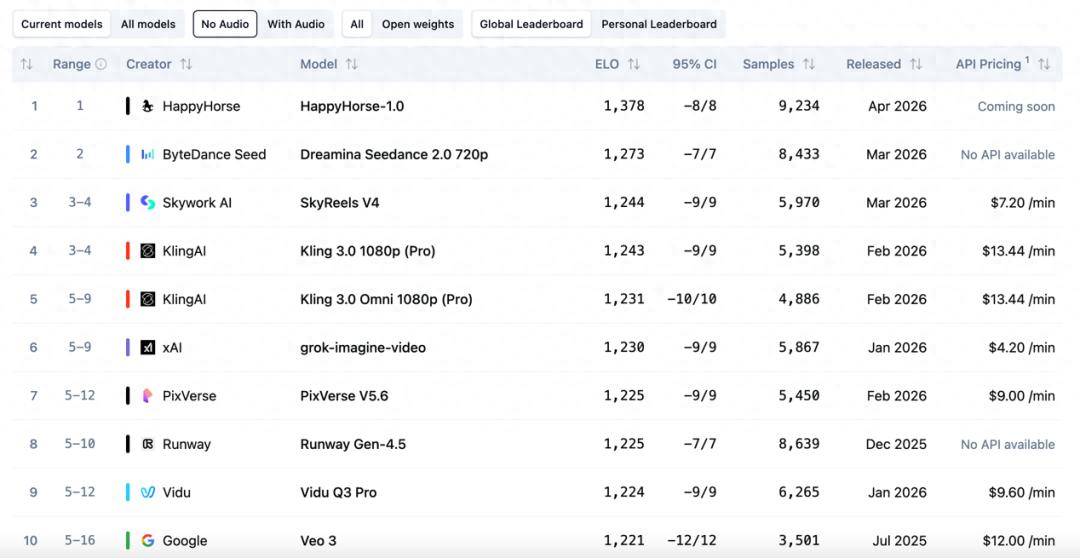
Seedance 2.0, released in February 2026, had been dominating the market, surpassing models like Sora 2 and Veo 3. The emergence of an anonymous model that outperformed it so quickly raised curiosity among netizens about its origins.
Speculations on the Development Team
Given that 2026 is the Year of the Horse in the lunar calendar, and considering the name “HappyHorse” resembles the earlier anonymous release of OpenRouter, which was later confirmed as Zhipu GLM-5’s “Pony Alpha,” many speculated it might originate from a Chinese team.
However, the term “Chinese team” is broad. Speculations on social media included possibilities like Tencent and Alibaba, as both companies’ founders share the surname Ma. Others suggested it could be Xiaomi, known for its previous anonymous model Hunter Alpha.
Two credible leads have emerged. First, X user Vigo Zhao compared HappyHorse-1.0’s public benchmark data (visual quality 4.80, text alignment 4.18, physical consistency 4.52, and word error rate 14.60%) with known models and found a high match with daVinci-MagiHuman, released on GitHub in late March 2026. Both models share a 150 billion parameter, 40-layer single-stream Transformer architecture, jointly generating audio and video, with identical language support and similar website descriptions.
The development team behind daVinci-MagiHuman is a collaboration between Sand.ai and the GAIR lab of Shanghai Jiao Tong University. Sand.ai’s founder, Cao Yue, is a Tsinghua University scholarship recipient and an ICCV 2021 award winner, focusing on autoregressive video generation since founding Sand.ai in 2023.
The second lead points to the “Future Life Lab” under Alibaba’s Taotian Group, led by Zhang Di. Reports suggest that this lab is behind HappyHorse. A webpage claiming to be HappyHorse’s official site mentioned Taotian Group’s affiliation, but its authenticity remains unverified.
Zhang Di has a strong background in AI video, having served as Vice President at Kuaishou from 2020 to 2025, where he built the underlying architecture for the Kuaishou large model, earning him the title “Father of Kuaishou.” After a brief stint at Bilibili in 2025, he returned to Alibaba to lead the Future Life Lab.
Performance Comparison
Beyond the Elo scores, how does HappyHorse perform? Early test videos suggest that HappyHorse competes closely with Seedance 2.0, sometimes even surpassing it, though it does not consistently appear to lead overall. For instance, in some tests, its physical realism seemed inferior to Seedance 2.0.
Tests conducted on the Artificial Analysis platform showed HappyHorse often outperformed other models, although a direct comparison with Seedance 2.0 was not possible. In a running scene, both HappyHorse and Veo 3.1 Preview had issues, but Veo exhibited additional flaws.
In a typing scene, HappyHorse executed prompts accurately, producing clear text, while Kling 2.6 Pro failed to comprehend actions correctly. In a more complex scene, HappyHorse accurately represented an architect’s work by generating corresponding blueprints, showcasing impressive detail.
Elo Rating Concerns
It’s important to note that the Video Arena’s Elo rating is based on real user blind voting, where users choose their preferred video. This mechanism reflects ordinary people’s visual perception but has structural limitations. If the blind test materials predominantly feature a specific scene type, models excelling in that area may achieve higher win rates.
Many testers noted that HappyHorse still has visible gaps compared to Seedance 2.0 in terms of character detail and dynamic coherence, raising doubts about whether Elo scores truly represent overall capability.
These concerns are valid. The Elo system accumulates preferences, and the final score largely depends on the types of test content users choose to submit. HappyHorse’s total votes remain unknown, while Seedance 2.0 has accumulated over 7,500 votes in the text-to-video category. As more votes come in, rankings may change.
Regardless of how rankings ultimately adjust, if the so-called “official website” and numerous GitHub repositories labeled “coming soon” are genuine, it would signify that an open-source video model has, for the first time, directly matched a mainstream closed-source competitor based on user perception in blind tests. This is beneficial for users, as Seedance 2.0, while effective, is costly and has long wait times, indicating a need for more options in the market.
Comments
Discussion is powered by Giscus (GitHub Discussions). Add
repo,repoID,category, andcategoryIDunder[params.comments.giscus]inhugo.tomlusing the values from the Giscus setup tool.